Stop Building a Hobby: How to Turn 30 Years of Expertise into Knowledge Assets That Pay
Your knowledge assets, meaning your experience, skills, and everything you’ve learned over the years, have been sitting in your head for three decades and most likely earning you nothing online.
Not because you lack expertise. You have more than enough. But somewhere between “I want to start a business” and “I want to help women feel better,” the actual business part got lost.
I need to say something a little uncomfortable here. Bear with me.
There are so many capable women who pour years into a blog or a coaching offer that goes nowhere. Too often, it is rarely a skill problem. It is a clarity problem.
They are building something that feels good to talk about instead of something that solves a specific, measurable problem someone would actually pay to solve.
There is a difference between those two things. A big one.
What Are Knowledge Assets and Why Is Nobody Being Honest About Them?
Intellectual capital is just a formal way of describing the value you’ve built up over the years that lives in your head. Human capital is the personal side of that. Your skills, your judgment, and your real-world experience.
And right now, people are building real income from what they already know, and you already have everything you need to do the same.
What you know only turns into income when it’s aimed at a real problem with a real outcome. Not a feeling. Something tangible.
Women who have spent 30 years in healthcare, finance, education, management, counseling, or any number of fields have something most online business beginners would genuinely kill for. You’re not missing the knowledge. It just hasn’t been packaged in a way that works online yet.

Is Your Expertise Actually Packaged Around an Outcome, or Is It a Vibe?
Here’s where I’m going to get direct with you because I think you can handle it.
This is the kind of experience you only get from years of doing the work. It’s knowing what’s wrong before anyone else sees it. It’s reading a situation quickly and trusting your judgment. This is your advantage, and it’s something no one can pick up from a few YouTube videos.
This is the part you can actually write down and share. It’s your processes, your steps, and the way you do things that others can follow, learn from, and pay for.
Both are genuinely valuable. But the part where a lot of women trip up on is that they package that knowledge into something vague. “I help women find their confidence.” “I support women through transitions.” Those are feelings, not outcomes. And feelings don’t have a clear price tag.
Your advantage isn’t just your warmth or your compassion, even though those matter. It’s the specific, real result you can help someone achieve because of everything you’ve lived and learned.
That’s what sells. Be specific enough that your ideal client reads your offer and thinks “that is exactly my problem.”
How Do You Turn Three Decades of Experience Into Information Assets That Pay?
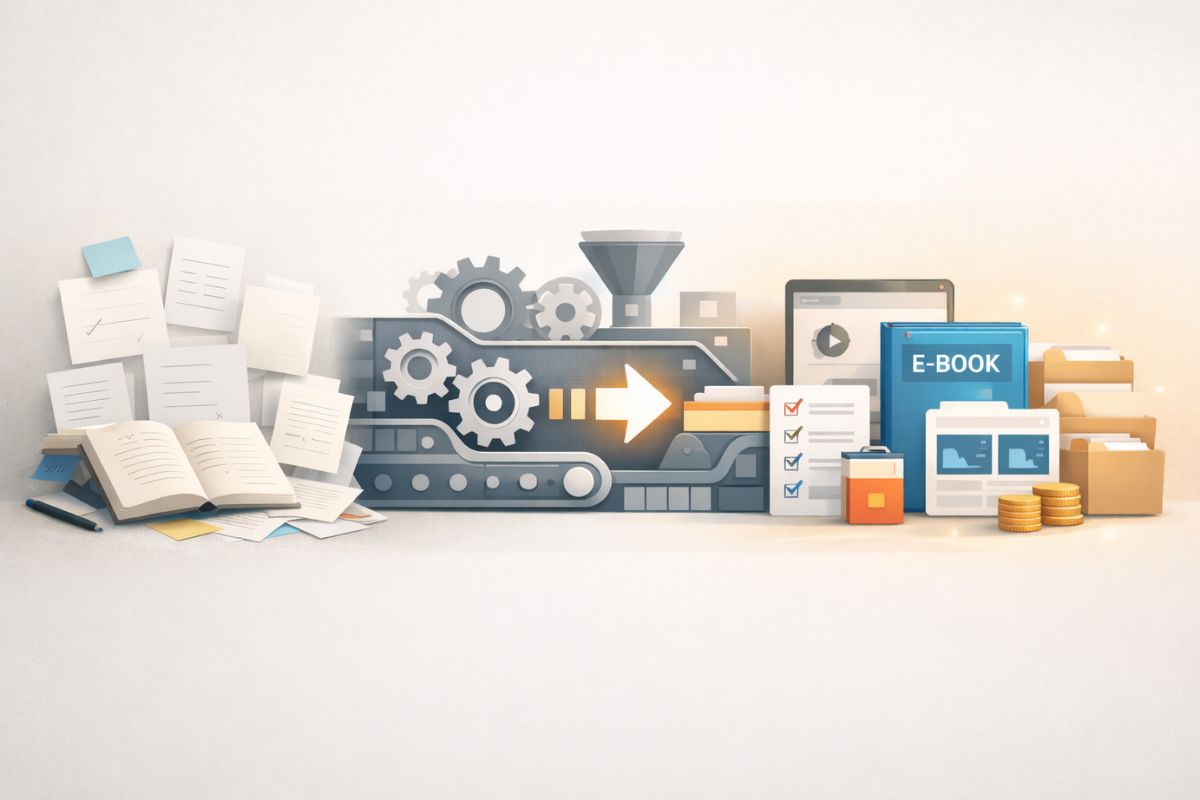
Information assets are what you create when you take what’s in your head and turn it into something someone else can actually use. This could be a course, a simple framework, or a downloadable guide. In other words, it’s a way of doing things that you can repeat with client after client.
This kind of knowledge creation is practical, not theoretical. You start by getting clear on the result you can help someone achieve, then you map out the steps to get them from where they are to where you know how to take them.
Sharing what you know is what makes this work. And when you turn that into something others can follow, that’s the product.
And the part most business advice skips entirely is that it’s okay that money is the goal. You’re allowed to build something because you want to earn from it.
Women who pretend the money doesn’t matter tend to price too low, sell too softly, and burn out before they ever see traction.
The women I’ve seen build real, sustainable income online all did the same thing. They got honest about what they were offering, why it mattered, and what it was actually worth. That’s what made everything start working.

What Does Knowledge Management Look Like When the Business Is You?
Big companies spend a lot of time and money documenting what their people know. Because they’ve learned the hard way that when it stays in someone’s head, it disappears when they’re gone.
The same logic applies to your solo business, even if “solo business” means you are in your home office with a cup of coffee.
Start a simple document on your computer right now. Call it whatever you want. Every time something works in your business, write it down.
That email subject line that got a ton of opens, document it. The way you explained your offer that made someone say “I need that.” Write it down so you don’t forget. The process you used that got a client a real result. Take notes
That document becomes your business library. And six months from now, when you’re tired, uninspired, and can’t quite remember what you said that one time that really worked, it’s right there. You don’t have to guess or start over. You just go back and use it again.
That’s all this is. Nothing fancy. Just you keeping track of what works so you don’t lose it.
Every time you finish working with a client, write down what worked. Every time a piece of content takes off, note why. Every time an offer flops, figure out what to change.
Over time, you stop starting from scratch every time. You’re just building on what you already know works. That’s really all this is. Your business gets better because you do.
Why Do Smart, Capable Women Still Undercharge for Their Knowledge?
You’re not getting paid for your time or how hard you’ve worked over the years. You’re getting paid for the value someone believes they’ll get from you. That’s what actually drives this.
At some point, you have to admit something a little uncomfortable. You’re building a business, not a support group. Wanting to help people comes from a real place, and it does matter.
But when a business is centered around healing yourself or processing your own journey out loud, it usually doesn’t turn into real income. Not because it isn’t meaningful, but because there’s no clear outcome for the person on the other side.
My coach and mentor Sadie Smiley, founder of Passive Income Pathways, has been watching online businesses succeed and fail for two decades. Her take is blunt and I think she’s right: the businesses that go nowhere are almost always built around the founder’s healing journey instead of the buyer’s specific problem.
The women I’ve seen build real income online went into it to make money. They also happened to help an enormous number of people along the way. Those two things are not in conflict. But you have to be willing to say the first part without apologizing for it.
Pay attention to what your audience keeps asking you. That’s not a small thing. Those questions are your next offer, your next article, your next product.
The women who make this work aren’t always the smartest or the most credentialed. They’re the ones who pay attention. They listen, they adjust, and they keep going.
Your frameworks from five years ago might need a refresh. The way you explained something to your first client probably isn’t how you’d explain it now.
That kind of adjusting and improving is what people call innovation management. But at your level, it doesn’t look like strategy meetings. It just looks like paying attention.

How Do You Actually Start Treating Your Knowledge Assets Like a Real Business?
Your knowledge assets are worth exactly as much as you decide to charge for them. And that number needs to be based on the value of the outcome you deliver, not on what feels polite.
Spend some time this week writing down the specific problems you’ve solved, for clients, for colleagues, for yourself, that other people are still struggling with.
Not vague themes but specific problems. Not “I help with stress” but “I help managers restructure how their teams communicate so conflict stops derailing every project.”
Not “I support women in transition” but “I help women who’ve left a long career figure out exactly what to do next in the first six months.”
Those are knowledge assets packaged into offers. Those are things you can price, sell, and deliver with confidence.
Pick one. Build around it. Price it like someone with 30 years of directly relevant experience should price it.
Because thinking about starting doesn’t count. What matters is showing up with something specific to offer and having the confidence to put it out there.
Stuck Figuring Out What to Blog About?
Get this FREE worksheet to help you turn your expertise into a focused, profitable blog.
Frequently Asked Questions
What’s the difference between knowledge assets and having experience? Experience is raw material. Knowledge assets are what you get when you organize that experience into something teachable, repeatable, and valuable to a specific buyer. One sits in your head; the other earns money.
How do I know if my expertise is specific enough to sell? If your ideal client could read your offer and immediately recognize their exact problem in it, you’re specific enough. If they’d need you to explain who it’s for, keep narrowing.
Do I need formal credentials to monetize my expertise online? No. Demonstrated ability to help someone achieve a specific result matters far more than any certification. Decades of real-world experience often outweigh credentials in the eyes of buyers who’ve already tried the credentialed people.
What if I genuinely want to help people, not primarily make money? Those aren’t competing goals. You can help a lot of people and make good money doing it. But the business only survives if the money is real, so get honest about both motivations and build accordingly.
How long does it realistically take to earn from a knowledge-based business? With a clear offer pointed at a specific problem, most people see meaningful traction within six to twelve months of consistent effort. Vague offers aimed at a vague audience tend to take much longer, or stall entirely.
What’s the first concrete step if I’m starting from scratch? Write down five specific problems you know how to solve that someone else would pay to have solved. Not five ways you can generally help. Five specific, measurable outcomes. That list is your business plan.
What if I’ve been blogging for a while but not making money? Look at what you’re actually offering. If the answer is “content,” that’s not an offer. Turn your expertise into a product with a specific outcome and a price, then use your existing content to drive people toward it.