
Your Skills Inventory: What You Bring to the Table
Your skills inventory has been sitting in your head for decades, quietly accumulating value you’ve given away in boardrooms, break rooms, and volunteer committees without a second thought. You probably don’t see it as valuable anymore because it feels so ordinary to you. That’s the whole problem.
I want to walk you through how to pull all of that out of your head, look at it honestly, and figure out what someone would actually pay for. This isn’t a corporate HR exercise. This is you, finally treating yourself like the professional asset you are.
What Is a Skills Inventory and Why Does It Matter for Your Side Hustle?
A skills inventory is a complete picture of everything you know how to do, every subject you understand deeply, and every problem you’ve solved more times than you can count. It’s the starting point for any income-generating work, whether that’s consulting, teaching, writing, or coaching.
Most women over 50 stall out at the “I want to start something” stage because they skip this step. They go looking for business ideas before they’ve looked at what they already have. Then they spend months trying to build something from scratch when they’re sitting on something worth far more.
A solid skills assessment doesn’t require fancy software. It takes honesty, a cup of coffee, and about an hour.
How Do You Actually Do a Skills Assessment on Yourself?
Start with a blank page. Write down every job you’ve held. Every volunteer role. Every committee. Every crisis you’ve navigated, every system you’ve built, every person you’ve trained.
Then ask yourself: what did I actually do in each of those situations? Not your job title. What did your brain and judgment actually accomplish?
This is where competency mapping gets interesting. You might have a title like “office manager” but underneath that, you were doing budget oversight, conflict resolution, vendor negotiations, and onboarding.
Those are sellable skills. The title isn’t. Women who go back through their career history job by job almost always surface expertise they stopped counting years ago simply because it became second nature.
Get specific. “Good with people” is too vague. “Can calm down an angry client and leave them feeling heard” is a skill. The more specific you get, the more useful this becomes.

What Goes Into a Real Skills Audit?
A skills audit is when you look at what you have and honestly rate your level in each area. Think of it as a talent inventory taken by someone who wants accurate results, not flattery.
For each skill, ask yourself four things. Can I explain this to someone who knows nothing about it? Have I done it enough times to handle problems when they come up? Would someone pay me to do this or teach it? Could I do it without hand-holding?
If yes to most of those, you’ve found something worth building around. If you’re honestly shaky on one, that goes in a column called “skills development.” That’s not a dead end. It’s a roadmap.
This is also where starting a blog after retirement starts to make a lot more sense, because once you can see your skills laid out clearly, the content you should be creating becomes obvious.
How Do You Find the Gaps Between What You Have and What People Will Pay For?
This is the skills gap analysis part, and it’s worth doing before you spend months building something nobody asked for.
Look at your strongest areas. Then spend an hour where your ideal client actually hangs out. Facebook groups, forums, comment sections. Look at what questions come up over and over.
You’re doing a simple form of skills benchmarking, comparing what you have to what the market is actively looking for.
Sometimes the language you use to describe your skills doesn’t match how your audience describes their problems. That’s a translation issue, not a skills issue. You have what they need. You need to learn how to say it in a way that makes them lean forward.
Knowing your audience at this level also depends on knowing who you’re actually talking to. Women who’ve done the work of building a detailed reader avatar find this research goes much faster because they already know where to look and what to listen for.
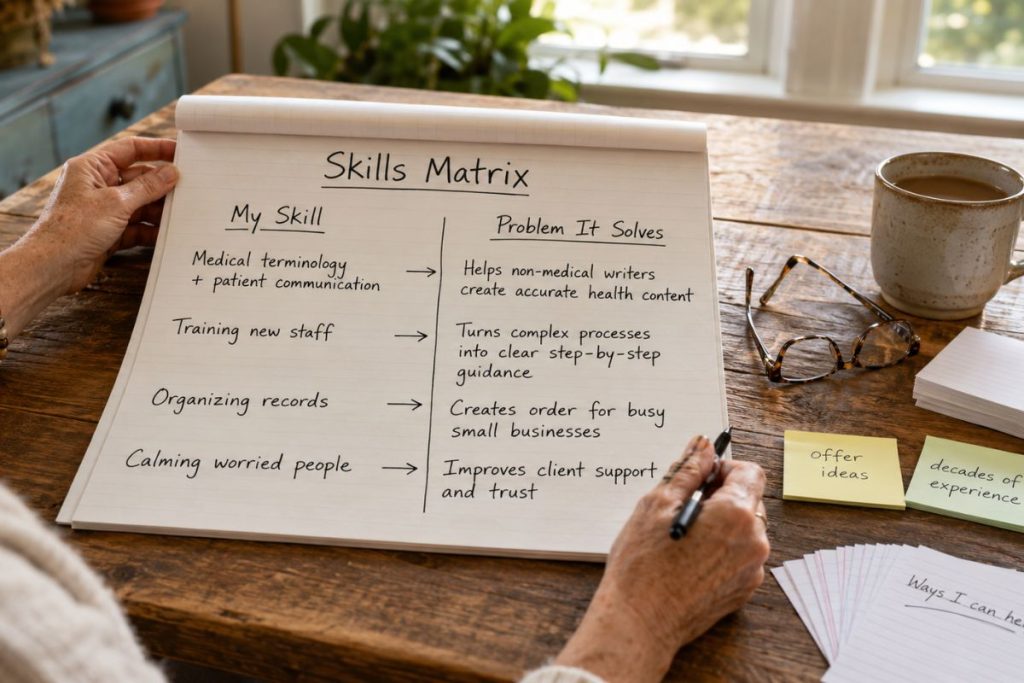
What Does a Skills Matrix Look Like for Someone Like You?
A skills matrix sounds corporate, but for your purposes it’s two columns on paper.
Column one is your skill. Column two is the problem that skill solves for someone else.
If you have decades in healthcare, you might write “medical terminology and patient communication” on one side. On the other side: “helps non-medical writers produce accurate health content.” This is skills profiling in action. It connects what you can do to who needs it done.
A skills catalog built this way becomes something you return to every time you wonder what to offer next. You’re not starting from zero. You’re shopping your own inventory.
How Do You Turn Your Skills Into a Portfolio That Builds Trust?
A skills portfolio is proof. It’s the difference between saying you can do something and showing someone you’ve already done it.
You don’t need a website right away. Start with examples of your work, results you’ve helped produce, and processes you’ve built. If you’ve trained people, that counts. If you’ve written internal guides or procedures, those are evidence.
The thing most women don’t realize is that their personal stories are part of the portfolio too. The moments where you figured something out the hard way, where you made the call nobody else wanted to make, where you built something from nothing.
Those lived experiences become some of the most compelling content you’ll ever produce, and they’re something no competitor can replicate.
Your skills portfolio might be as simple as a few writing samples, a case study from your career written in plain language, or a short video walking through how you’d approach a common problem.
The goal is that someone looking at it thinks: she knows what she’s doing. Personal branding follows naturally from that. You don’t have to fake confidence when you have real evidence.

How Do Your Skills Inventory and Your Income Connect?
This is the part nobody says clearly enough.
Skills identification only matters if it leads somewhere. Your skills analysis needs to end with a clear answer to this question: what specific result can I help someone achieve because of what I know?
Not a vague transformation. A specific outcome.
“I have 30 years of experience in finance” is not an offer. “I help small business owners set up bookkeeping systems they can actually maintain themselves” is an offer. One is a background. The other is something someone will pay for.
Your skills planning from here is simple. Pick the area where your skills are deepest, where the market has a clear need, and where you’d genuinely enjoy the work. That last part matters more than you think.
What Is Your Skills Inventory Telling You to Do Next?
Your skills inventory isn’t a document you file away. It’s a living picture of what you have to offer, and the most useful thing you can do with it is act.
Pick one area. Build one offer. Tell the right people about it.
Your skills have been building for decades. They’re ready to work for you now.
Frequently Asked Questions
What if I don’t think my skills are special enough to sell? The skills that feel most ordinary to you are often the most valuable to someone else. What takes you 20 minutes has taken others years to figure out. Start there.
Do I need a resume to do a skills inventory? Not at all. This is a thinking exercise. Pull from memory, from what you’ve done well, and from what people consistently ask for your help with.
How is this different from a skills assessment for a job search? A job search assessment matches you to someone else’s requirements. A side hustle skills inventory identifies what you can offer to solve a real problem for a paying client. The focus shifts from “what do employers want” to “what does my market need.”
What if my skills span multiple areas? Pick the area where your expertise is deepest, the problem is most concrete, and the client can most clearly see the result. Starting focused beats starting broad almost every time.
How often should I revisit my skills inventory? Every six months, or anytime you finish a client engagement or consider adding a new offer. It should grow with you, not sit in a drawer collecting dust.